
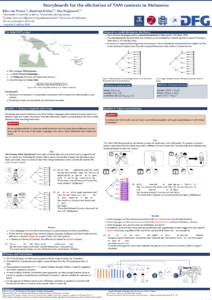
 The Linguistic Evidence conference in Tübingen this year is long over and I’m sad I couldn’t be there, but our poster was well represented by my two co-authors, Manfred Krifka and Ana Krajinović. Click here to download the PDF.
Blog
Perspectives on Low-Resource Languages and Language Varieties
 My colleague Stefania Degaetano-Ortlieb and I, with generous support from Elke Teich, organised a workshop last week. We invited researchers from a variety of backgrounds, spanning language documentation, typology, language acquisition, computational linguistics and historical linguistics. We were very happy with the inspiring talks and vibrant discussions about challenges and solutions, which I am sure will continue beyond the small event we had.
Last talk of 2017, at the MPI for the Science of Human History
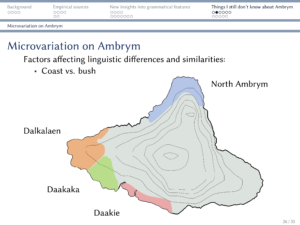 2017 was a year full of talks, so don’t be surprised if you won’t see me on the circuit as much during 2018. The last talk of that year was at the MPI in Jena, where I talked about some of the things you’ll see if you compare languages based on corpus data that you’re likely to miss if you look at grammatical descriptions. I had some incredibly inspiring conversations and hope to visit more often (maybe even in 2018).
Multi-verb constructions — is there a continuum?
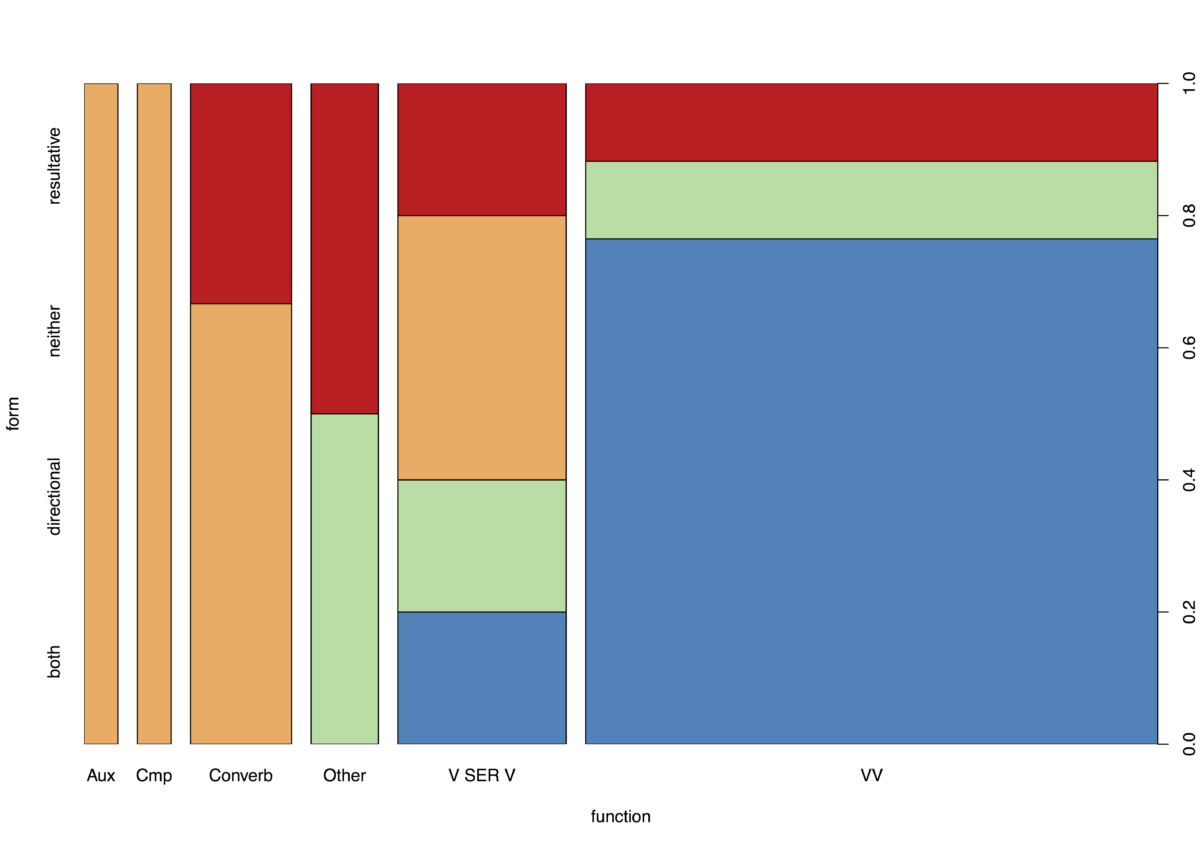
I’m excited about the upcoming workshop on Multi-verb constructions at ZAS Berlin. I’m going to use the opportunity to present some of my latest thoughts on the topic and lobby for systematic typological comparison. See my slides here.
The syntax-morphology trade-off
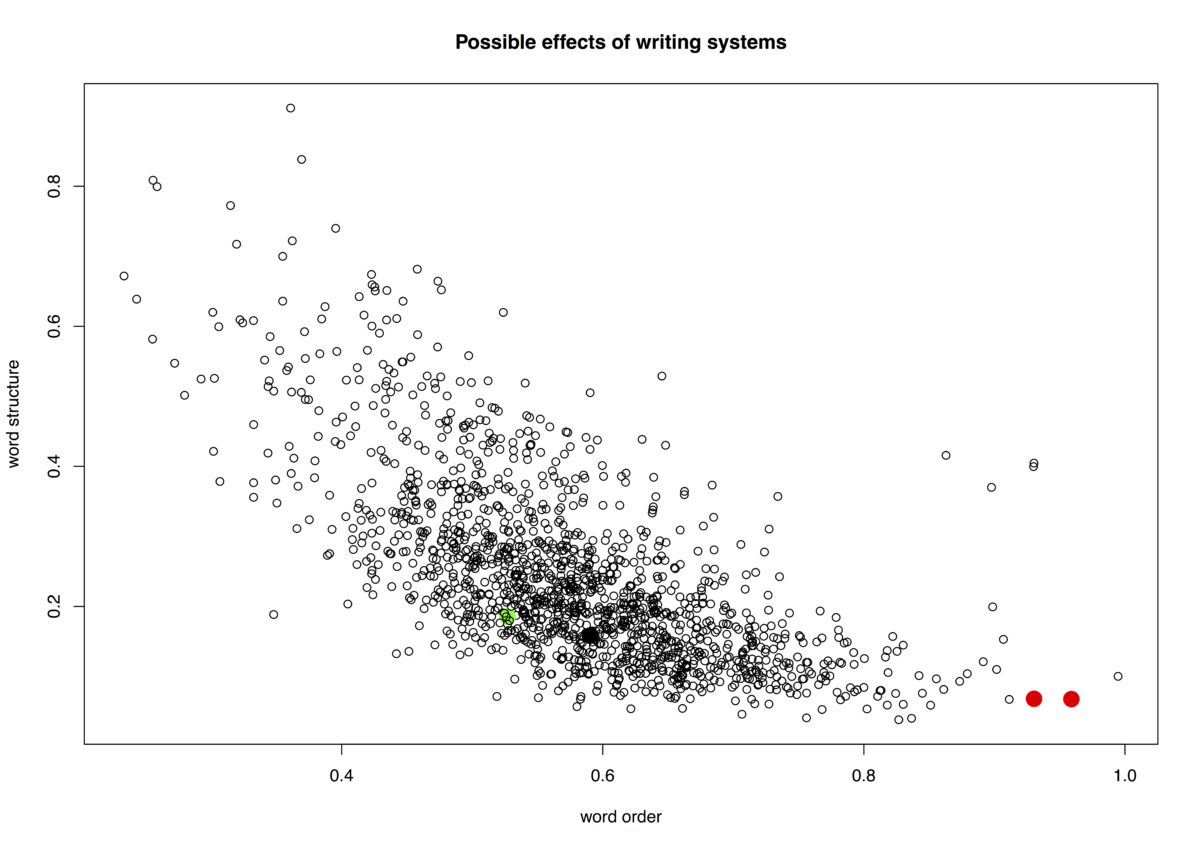
Yesterday, I gave a talk at the Language Science Colloquium at Universität des Saarlandes, about recent research on the syntax-morphology trade-off and further perspectives for text-based typology. Download the slides here.
Bibtex bibliographies selected by keywords, with customised keyword separators
This is a very specialised problem, but since I just found the solution, I wanted to briefly document this for myself. I usually use natbib, but for the preparation of reading lists, sorted by topic, I wanted to try biblatex. Creating a list of references selected by a keyword is not a problem at all.
Continue reading “Bibtex bibliographies selected by keywords, with customised keyword separators”
Starting in Saarbrücken: Information density, complexity and cross-linguistic variation
 It’s October already and I have just received my appointment as a guest professor in the SFB (special research unit) on Information density in Saarbrücken. I will teach a class on “Cross-linguistic variation in structural complexity” and I’m excited to learn more about information density and possible applications of existing hypotheses and tools to typological comparison.
Upcoming workshop: Data management and corpus creation
I’m looking forward to this week’s CLARIN-D workshop on data management and corpus creation in Hamburg. As a member of F-AG 3, I’ll be attending with a short talk and am curious to learn more about current practices and experiences.
Now out: Dozing eyes and drunken faces
 In many languages of the world, emotions and medical conditions are not attributed to an individual, but to a certain body part. For example, instead of saying “I am sad”, you may have to say something along the lines of “my heart is heavy” in many languages. In these cases, the meaning of “being sad” does not reside in a single word. “Heart” alone does not express sadness, and neither does “heavy”. Only the combination of the two can express this concept. The question is then how such languages form expressions that refer to an abstract emotion such as “sadness” . And the answer is that there are different strategies. One strategy is to say something like “the heaviness of the heart”. The Oceanic language Daakaka, however, uses a different strategy. Here, an emotion concept is expressed by a structure such as “the heavy heart”. This paper investigates these differences and their implications. Get it here or ask me for the preprint.
Prepare your LaTeX document for publication
When your manuscript has been accepted for publication, and you have adjusted the layout to the publisher’s requirements, these are the final steps before submission:
Continue reading “Prepare your LaTeX document for publication”