

There was a wonderful small conference on Ideologies and Linguistic Ideas in beautiful Tbilisi last week, and I’m very happy I had the opportunity to team up with my colleague Marcin Kilarski to present some of our work on bias and ideologies in old and new debates on linguistic complexity. I also learned a lot about the role of ideologies in the history of linguistics, which is new and exciting territory to me. Download our slides here.
Author: admin
Realis and Irrealis at ALT, Pavia

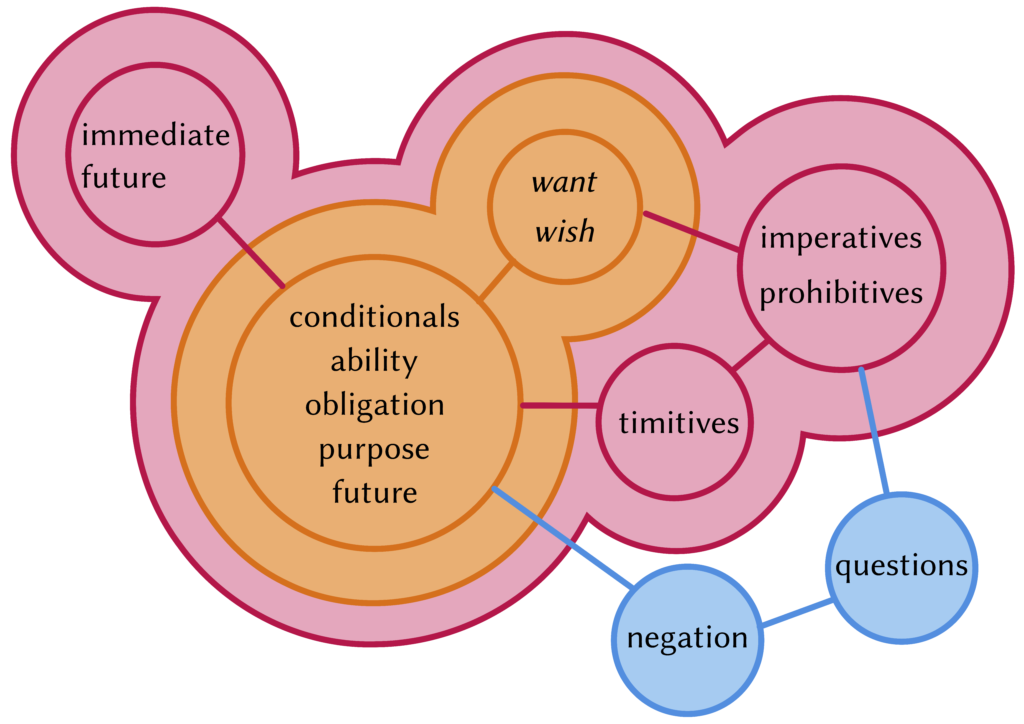
I heard many fantastic talks at this year’s ALT in Pavia and had some very inspiring conversations. The talk I gave was about realis and irrealis in Oceanic and beyond, and you can download the slides here.
SLE in Leipzig: TAM across languages

Together with my two fantastic co-organizers Ana Krajinović and Jozina Vander Klok, I just hosted a workshop on tense, aspect and modality across languages at this year’s SLE in Leipzig. We had awesome presentations and inspiring discussions, learned a lot and had great fun.
Out now: Mapping irreality
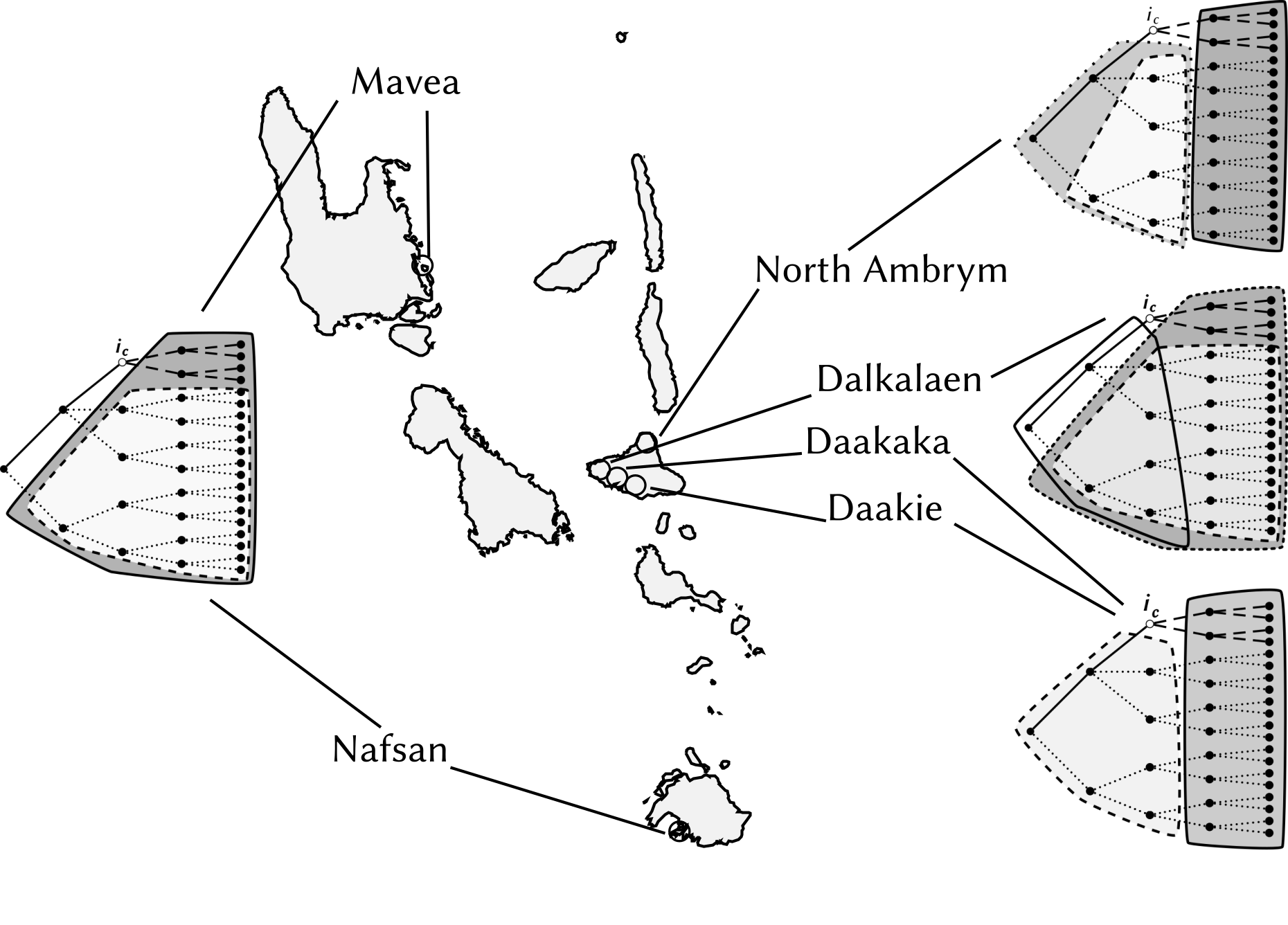 Our paper on how to map the modal-temporal semantics of TAM markers in Oceanic languages empirically is now out in the proceedings of Linguistic Evidence 20.
APLL in Leiden
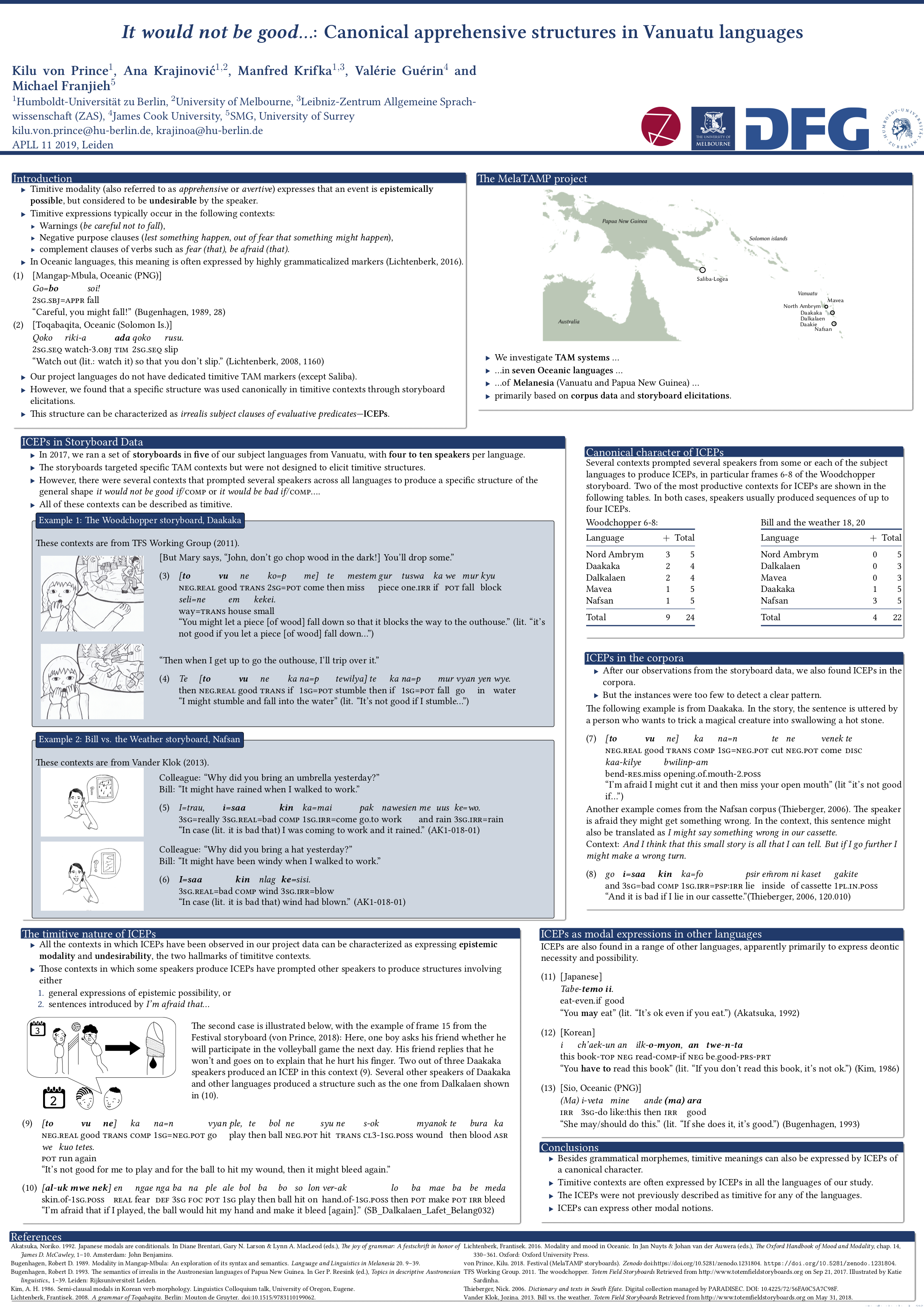 My colleagues Ana Krajinović and Manfred Krifka are currently at APLL in Leiden to present our joint work on timitive structures in Oceanic, which have the shape it’s not good/it’s bad if… . Timitive modality is a category often found in Oceanic, which typically occurs in warnings (Watch out, you might fall!) or negative purpose clauses (You should take an umbrella, lest you get wet!). Download the poster here.
Out now: Counterfactuality and Past
My article on counterfactuality and past is out now, and it’s free to access. In 2011, while I was working on the Daakaka grammar, I looked at the system of TAM markers and asked myself how hard it would be to figure out their meanings. Manfred Krifka suggested I start working with branching time to account for the realis/irrealis distinction, which I did. Except that the distinction we find in the Daakaka system isn’t binary, but tripartite.
Continue reading “Out now: Counterfactuality and Past”MelaTAMP at LTC 19 in Poznań
Our project was represented with two papers in this year’s Language and Technology Conference in Poznań. Ana Krajinović presented joined work with colleagues from Vanuatu and Melbourne on community-led language documentation. She won the award for the best student presentation.
Annika Tjuka, in a joined paper with Lena Weißmann and me, presented our tag set for the MelaTAMP corpora with a focus on tagging habitual aspect: the fact that habituality or genericity can be a property of stretches of discourse larger than a sentence makes clause-wise tagging complicated.
Diversity linguistics in Cologne
I’m currently in Cologne at the small Vielfaltslinguistik Conference (Diversity linguistics). It’s great to see so much new and interesting work on lesser described languages. My own talk, on joined work with Manfred Krifka and Ana Krajinović, focuses on empirical methods in our MelaTAMP project. Our slides can be downloaded here: [download id=”473″].
Habituality in four Oceanic languages
Our article (with Ana Krajinović, Anna Margetts, Nick Thieberger and Valérie Guérin) is out now and currently available for free here. In this article, we talk about habitual aspect in four Oceanic languages and demonstrate how it is (or isn’t) typically expressed. Reduplication and imperfective aspect play a particularly prominent role, sometimes in combination with each other.
International Linguistics Olympiad

Germany will participate in this year’s Olympiad of Linguistics in Yongin, Korea, and I am part of the small team of people who are organising the selection and training of the German team. We’ll have two rounds of online tests before inviting the finalists to our Berlin boot camp.